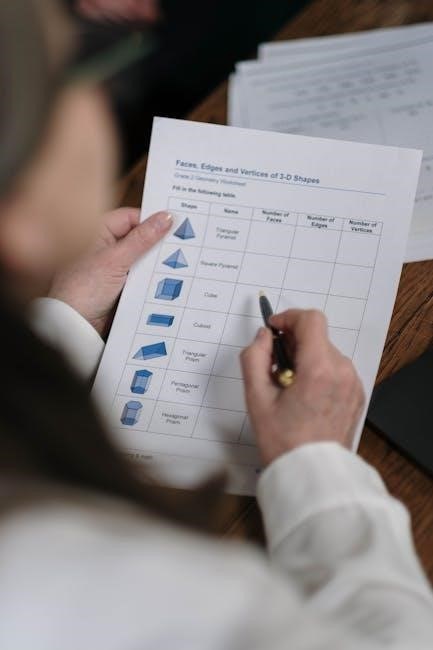
Year 1 Maths Worksheets PDF Free Download: A Comprehensive Guide (Updated February 18, 2026)
Discover a fantastic resource! This curated collection provides eight progressive steps for Year 1 maths instruction,
aligned with the White Rose Maths scheme, offering worksheets, notes, and enriching extension activities.
Year 1 marks a pivotal stage in a child’s mathematical journey, building foundational skills crucial for future success. This year focuses on developing a concrete understanding of numbers, simple calculations, and basic shapes. It’s where children transition from counting objects to grasping numerical concepts.
Worksheets play an incredibly important role in reinforcing these concepts. They provide focused practice, allowing children to solidify their understanding at their own pace. Free, printable worksheets are particularly valuable, offering accessible learning resources for parents and educators alike. They allow for repeated practice of key skills, identifying areas where a child might need extra support.
Effective worksheets aren’t just about rote memorization; they encourage problem-solving and critical thinking. They bridge the gap between classroom learning and home practice, ensuring consistent skill development. Utilizing PDF format ensures easy access and printing, making learning convenient and readily available whenever and wherever it’s needed.
Why Use Free Printable Worksheets?
Accessibility is a primary benefit; free printable worksheets eliminate cost barriers to quality educational resources. This is particularly helpful for parents homeschooling or seeking supplemental learning materials. PDF format ensures compatibility across various devices, allowing easy viewing and printing from computers, tablets, or smartphones.
Convenience is another key advantage. Worksheets can be downloaded and printed instantly, providing immediate learning opportunities. They offer focused practice on specific skills, allowing children to target areas needing improvement. This targeted approach is more efficient than generalized practice.
Flexibility is also crucial. Worksheets can be adapted to suit individual learning styles and paces. They provide a tangible learning experience, which can be beneficial for kinesthetic learners. Furthermore, they offer a valuable assessment tool, allowing educators and parents to track progress and identify areas requiring further attention.
Key Areas of Year 1 Maths Curriculum

Year 1 Maths builds foundational skills across several core areas. A significant focus lies on Number and Place Value, encompassing counting, understanding numbers, and grasping number bonds. Worksheets in this area reinforce these concepts through engaging activities.

Addition and Subtraction are introduced, initially within 10, utilizing visual aids like number lines. These worksheets help children develop fluency and problem-solving skills. Shape, Space, and Measure are also vital, with children learning to recognize 2D shapes and understand basic spatial language and measurement concepts.
Early Fractions, specifically halves, are introduced to lay the groundwork for future mathematical understanding. Finally, Data Handling skills, such as sorting and creating simple pictograms, are developed, fostering analytical thinking. Free PDF worksheets provide targeted practice in each of these essential areas, supporting a well-rounded mathematical foundation.
Number and Place Value
Number and Place Value form the cornerstone of Year 1 maths, and readily available PDF worksheets are crucial for practice. Children begin by Counting to 20 and Beyond, developing fluency and understanding of number sequences. Worksheets focus on recognizing patterns and skip counting.
Understanding Numbers 1-10 is paramount, with activities centered on identifying, representing, and ordering these numbers. Number Bonds to 10 are introduced, building a foundation for addition and subtraction. Free worksheets provide repetitive practice to solidify these bonds.
Comparing Numbers (Greater Than, Less Than) is also key, using symbols and visual representations. These worksheets help children develop a sense of number magnitude and comparison skills, essential for future mathematical concepts.
Counting to 20 and Beyond
Mastering counting to 20 and beyond is a fundamental skill in Year 1, and free PDF worksheets offer targeted practice. These resources typically begin with counting objects within a set, progressing to counting sequences on a number line. Worksheets often include activities where children fill in missing numbers or continue counting patterns.
Beyond 20, worksheets introduce the concept of tens and ones, laying the groundwork for understanding place value. Children practice counting in 2s, 5s, and 10s, reinforcing number recognition and skip-counting skills. Visual aids, like number tracks and hundred squares, are frequently incorporated.
Effective worksheets will include varied exercises, such as counting forwards and backwards, identifying numbers before and after a given number, and applying counting skills to solve simple problems.
Understanding Numbers 1-10
Building a solid foundation with numbers 1-10 is crucial in Year 1. Free PDF worksheets focus on number recognition, formation, and value. Activities commonly involve matching numerals to quantities, identifying numbers within a sequence, and writing numbers correctly.
Worksheets often feature engaging visuals, like pictures of objects to count, allowing children to connect the numeral with its corresponding quantity. They also include exercises where children circle or color specific numbers, reinforcing visual discrimination.
Developing number sense is key; worksheets may ask children to compare quantities (“more than,” “less than”) or to order numbers from smallest to largest. Practicing subitizing – instantly recognizing small quantities – is also frequently included, preparing them for future mathematical concepts.
Number Bonds to 10
Mastering number bonds to 10 is a cornerstone of Year 1 maths, and readily available PDF worksheets provide targeted practice. These resources focus on understanding that numbers can be broken down into pairs that add up to ten, like 6 + 4 or 2 + 8.
Worksheets typically present number bonds visually, using images like ten frames or part-whole models to help children conceptualize the relationships between numbers. Exercises involve completing missing number sentences (e.g., 7 + ? = 10) and identifying all the number bond pairs.
Interactive activities, such as coloring or drawing to represent number bonds, are common. The goal is to build fluency and automaticity with these essential facts, which are foundational for addition and subtraction skills later on. Consistent practice with these free resources is invaluable.
Comparing Numbers (Greater Than, Less Than)
Developing an understanding of ‘greater than’ and ‘less than’ is crucial in Year 1. Free PDF worksheets offer engaging ways to practice this skill, often utilizing visual aids to support learning. These resources introduce the symbols > and <, helping children to represent comparisons accurately.
Worksheets commonly feature pairs of numbers, requiring students to insert the correct symbol to show which number is larger or smaller. Activities also include ordering numbers from smallest to largest, or largest to smallest, reinforcing the concept of numerical value.
Many worksheets incorporate pictorial representations – like groups of objects – to visually demonstrate quantity. This helps children connect the abstract symbols to concrete amounts. Consistent practice builds confidence and lays a strong foundation for more complex mathematical comparisons.
Addition and Subtraction
Mastering basic addition and subtraction is a cornerstone of Year 1 maths. Free printable worksheets provide a wealth of opportunities to build fluency in these essential operations. Resources begin with introducing the concepts of ‘adding to’ and ‘taking away’ using concrete objects and pictorial representations.
Worksheets progress to simple number sentences within 10, encouraging children to find the total or the difference. Visual aids, like number lines and ten frames, are frequently incorporated to support understanding and problem-solving.
A key focus is developing strategies for recalling number facts. Worksheets often present addition and subtraction problems in various formats, promoting flexibility and reinforcing the connection between operations. Consistent practice with these PDFs builds a solid foundation for future mathematical learning.
Beginning addition in Year 1 focuses on combining sets and understanding the concept of ‘adding to’. Free PDF worksheets initially present addition using visual aids like pictures of objects – apples, balls, or toys – allowing children to physically count and combine groups.
These introductory worksheets emphasize the ‘+’ symbol and the word ‘plus’, gradually transitioning to simple number sentences like 1 + 1 = 2. The worksheets often encourage children to draw their own representations to solidify their understanding.
A crucial element is relating addition to real-life scenarios, such as ‘If you have two cookies and I give you one more, how many do you have?’. Worksheets build confidence by starting with small numbers and progressively increasing the challenge, fostering a positive attitude towards maths.
Introducing subtraction in Year 1 centers around the idea of ‘taking away’ and finding the difference between sets. Free PDF worksheets commonly utilize visual representations, like crossing out objects from a group, to demonstrate the concept of removing items.
Early worksheets introduce the ‘-‘ symbol and the word ‘minus’, presenting simple number sentences such as 3 ‒ 1 = 2. Children are encouraged to use their fingers or draw pictures to help them visualize the subtraction process.

Connecting subtraction to everyday situations is key – for example, ‘If you have five balloons and one pops, how many are left?’. Worksheets start with smaller numbers and gradually increase in difficulty, building a solid foundation for more complex subtraction skills.
Addition and Subtraction within 10
Mastering addition and subtraction within 10 is a cornerstone of Year 1 maths. Free PDF worksheets focus on fluency through repeated practice with various methods. These often include number bonds, using number lines, and visual aids like pictures of objects to represent quantities.
Worksheets present a mix of addition and subtraction problems, encouraging children to choose the correct operation. They’ll encounter problems like 5 + 3 = ? and 8 ‒ 2 = ?, building confidence in their ability to solve simple equations.
A key focus is on understanding the relationship between addition and subtraction – recognizing that they are inverse operations. Worksheets may present fact families (e.g., 2 + 3 = 5, 5 ‒ 3 = 2) to reinforce this connection, solidifying their understanding.
Using Number Lines for Addition & Subtraction
Number lines are invaluable tools for Year 1 students learning addition and subtraction. Free PDF worksheets heavily utilize them to visually represent mathematical operations, making abstract concepts more concrete and accessible.
Worksheets typically feature pre-drawn number lines, prompting children to ‘jump’ forward for addition and backward for subtraction; Problems like 3 + 2 are solved by starting at 3 and hopping two spaces to the right, landing on 5. Similarly, 7 ‒ 4 involves starting at 7 and hopping four spaces left.
These exercises build a strong conceptual understanding of how addition increases quantity and subtraction decreases it. Worksheets often progress in difficulty, introducing larger numbers and requiring students to draw their own number lines, fostering independence and problem-solving skills.
Shape, Space and Measure
Year 1 maths worksheets focusing on shape, space, and measure introduce fundamental geometric concepts and early measurement skills. PDF resources commonly include activities centered around recognizing and naming 2D shapes – squares, circles, triangles, and rectangles – often requiring children to identify them in everyday objects.
Worksheets also develop spatial reasoning through exercises using directional language like ‘above,’ ‘below,’ ‘beside,’ and ‘in front of.’ Children might be asked to describe the position of objects relative to each other, or follow instructions to place items accordingly.
Early measurement concepts are introduced through comparing length and height. Worksheets may involve ordering objects by size or using non-standard units (like cubes or hands) to measure length, laying the groundwork for formal measurement later on.
Recognising 2D Shapes (Square, Circle, Triangle, Rectangle)
Free Year 1 maths worksheets dedicated to 2D shape recognition are readily available as PDFs. These resources typically begin with identifying squares, circles, triangles, and rectangles, often presented with colourful illustrations. Activities include circling specific shapes within a group, matching shapes to their names, and drawing these basic forms.
More advanced worksheets challenge children to find 2D shapes within pictures of real-world objects – for example, identifying a rectangular door or a circular plate. Some PDFs incorporate shape sorting exercises, requiring students to categorize shapes based on their properties.
These foundational skills are crucial for developing geometric understanding. Worksheets often include tasks where children count the sides and corners of each shape, reinforcing their understanding of shape attributes.
Understanding Spatial Language (Above, Below, Beside)
Free Year 1 maths worksheets focusing on spatial language – above, below, beside, in front of, behind – are excellent for developing early positional vocabulary. These PDFs commonly feature simple illustrations depicting objects in various arrangements. Children are tasked with describing the position of one object relative to another.
Typical exercises involve answering questions like “Is the ball above or below the box?” or circling the object that is “beside” a specified item. Worksheets often progress to include more complex scenarios with multiple objects and directional terms.
Visual aids are key; many PDFs utilize colourful pictures of animals or everyday objects to make learning engaging. These resources build a foundation for understanding maps, giving directions, and describing locations effectively.
Year 1 maths worksheets PDF downloads introducing measurement typically begin with non-standard units – using cubes, hands, or paperclips to measure length and height. This allows children to grasp the concept of measurement before introducing rulers and centimetres.
Common activities involve comparing the length of different objects (“Which is longer, the pencil or the crayon?”) and ordering them from shortest to longest. Worksheets often present pictures of objects where children estimate and then measure using provided units.
Focus is on vocabulary – length, height, longer, shorter, tallest, shortest. Later worksheets may introduce the idea of using a ruler, but initially, the emphasis is on hands-on exploration and comparative measurement, building a solid foundational understanding.
Fractions
Year 1 maths worksheets PDF resources introduce fractions through the concept of halves. This isn’t about formal fraction notation initially, but rather understanding ‘splitting something into two equal parts.’ Visual representations are key – worksheets commonly feature shapes like circles and squares divided in half.
Activities focus on identifying a half of a shape or a quantity. For example, “Colour half of the circle” or “Share these 6 cookies equally between two friends – how many does each get?” Emphasis is placed on the idea of equal sharing and recognizing that two halves make a whole.

Worksheets avoid complex fractions; the goal is to build a concrete understanding of ‘one half’ as a fundamental concept. Practical, real-life examples are often used to reinforce learning, making fractions relatable and accessible.
Free Year 1 maths worksheets PDF focusing on halves begin with visual learning. Children are presented with shapes – circles, squares, rectangles – and asked to identify or create two equal parts. The emphasis is on understanding the concept of ‘equal’ sharing; worksheets often use scenarios like sharing food items equally between two friends.
Initial activities avoid formal fraction notation (1/2). Instead, children colour one half of a shape, or divide objects into two equal groups. Worksheets frequently include prompts like, “Divide this pizza equally between two children.” This builds a concrete understanding before introducing symbolic representation.
The goal is to establish that a half represents one of two equal parts, and that two halves combine to form a whole. These worksheets lay the foundation for more complex fraction concepts later on, using relatable and visual examples.
Data Handling
Year 1 maths worksheets PDF resources for data handling introduce foundational skills in collecting, organizing, and interpreting information. A primary focus is on sorting objects based on attributes like colour, shape, or size. Worksheets present sets of objects and ask children to group them according to specific criteria, reinforcing observational skills.
Building on sorting, children progress to creating simple pictograms. These worksheets provide templates where children represent data using pictures or symbols. For example, a pictogram might show favourite fruits, with each fruit represented by a specific number of images.
The emphasis is on interpreting the pictograms – answering questions like “Which fruit is the most popular?” or “How many children chose apples?”. These activities develop early statistical reasoning and the ability to draw conclusions from visual data representations.

Sorting Objects

Free Year 1 maths worksheets PDF focusing on sorting objects are crucial for developing early mathematical thinking. These worksheets typically present children with collections of items – pictures of toys, shapes, fruits, or everyday objects – and task them with grouping these items based on shared characteristics.
Common sorting criteria include colour, shape, size, and type. Worksheets might ask children to “Sort the shapes into circles and squares” or “Group the red objects together.” This reinforces the ability to identify and articulate attributes, a foundational skill for classification.
More advanced worksheets introduce multiple criteria, requiring children to sort objects in two ways simultaneously. This encourages logical reasoning and problem-solving. The goal is to build a strong understanding of categorization before moving onto more complex data handling concepts.
Creating Simple Pictograms
Year 1 maths worksheets PDF dedicated to pictograms introduce children to a visual way of representing data. These worksheets typically present a simple question or survey – “What is your favourite fruit?” – and provide a grid where children can record their responses using pictures.
Each picture represents one vote, fostering a one-to-one correspondence understanding. Worksheets guide students to draw a specific symbol (e.g., an apple) for each person who chose that option. They then learn to interpret the pictogram by counting the symbols in each category;
These early pictograms focus on simple data sets with a limited number of categories. The emphasis is on the process of data collection and visual representation, building a foundation for more complex graph interpretation later on.
Resources for Free Year 1 Maths Worksheets (PDF)
Finding high-quality, free Year 1 maths worksheets in PDF format is easier than you think! Several excellent online platforms offer a wealth of resources to support your child’s learning journey. White Rose Maths provides downloadable worksheets directly aligned with their popular scheme of work, offering a structured approach to learning.
Topmarks is another fantastic resource, boasting a diverse collection of interactive maths games and printable worksheets covering various Year 1 topics. Twinkl offers an extensive library, though some content requires a subscription, many free worksheets are available.
Hamilton Trust also provides free maths resources, including detailed lesson plans and accompanying worksheets. These platforms ensure access to engaging and effective learning materials, supporting both classroom teachers and homeschooling parents.
White Rose Maths Year 1 Resources
White Rose Maths stands out as a premier provider of free Year 1 maths worksheets, meticulously designed to complement their renowned scheme of work. Their resources are structured around a progressive learning journey, ensuring a solid foundation in key mathematical concepts. You’ll find downloadable worksheets for each ‘step’ within their curriculum, covering areas like number, addition, subtraction, and shape.
Each worksheet is accompanied by helpful teacher notes, offering guidance on how to effectively deliver the lesson and support student understanding. Furthermore, extension activities are included to challenge more advanced learners. The clear layout and focused content make White Rose Maths resources incredibly user-friendly for both educators and parents seeking supplementary materials.
Topmarks Year 1 Maths Worksheets
Topmarks offers a vibrant collection of Year 1 maths worksheets and interactive games, providing a fun and engaging way for children to practice essential skills. While not exclusively PDF downloads, many resources can be easily printed for offline use. Their worksheets cover a broad range of topics, including counting, number bonds, shapes, and simple problem-solving.

A key strength of Topmarks is its interactive nature; games reinforce learning through playful activities. The site categorizes resources by year group and topic, making it simple to find relevant materials. Teachers and parents appreciate the variety and accessibility of Topmarks’ offerings, which cater to different learning styles and provide opportunities for both independent practice and guided instruction.

Twinkl Year 1 Maths Worksheets
Twinkl is a highly popular platform renowned for its extensive library of Year 1 maths worksheets, readily available as PDF downloads. Offering both free and premium resources, Twinkl caters to diverse needs with a vast selection covering all areas of the Year 1 maths curriculum. Expect to find worksheets focusing on number recognition, addition, subtraction, shapes, measurement, and more.
The platform’s strength lies in its comprehensive coverage and high-quality design. Worksheets are visually appealing and differentiated to support various learning levels. Twinkl also provides accompanying resources like answer keys and guidance notes for teachers and parents. A subscription unlocks access to an even wider range of materials, including interactive activities and lesson packs, making it a valuable tool for educators.
Hamilton Trust Year 1 Maths Worksheets
The Hamilton Trust provides a wealth of free, high-quality Year 1 maths worksheets in PDF format, designed to complement their complete maths schemes. These resources are particularly valued for their focus on conceptual understanding and problem-solving skills, rather than rote memorization. Expect a strong emphasis on practical, hands-on activities alongside traditional worksheet practice.
Hamilton Trust’s materials are structured into ‘blocks’, each addressing a specific mathematical concept. Worksheets are accompanied by detailed teacher guidance, including learning objectives, suggested activities, and differentiation ideas. While the full schemes require a subscription, a significant number of individual worksheets and resources are freely accessible, making it an excellent option for targeted practice and reinforcement of key skills.
Tips for Using Year 1 Maths Worksheets Effectively
Maximize learning with thoughtful worksheet integration. Begin by assessing your child’s understanding before assigning worksheets – identify areas needing support. Don’t treat worksheets as simply ‘work’; make them interactive! Encourage children to explain their reasoning aloud, using manipulatives like counters or number lines alongside the paper.
Keep sessions short and focused, preventing overwhelm. Celebrate effort and progress, not just correct answers. Use worksheets as a springboard for further exploration – can they create their own problems? Vary the activities; combine worksheets with games and practical tasks. Remember differentiation is key; adapt worksheets to suit individual needs, offering scaffolding or extension activities as required.
Adapting Worksheets for Different Learning Needs
Catering to diverse learners is crucial. For children needing extra support, simplify worksheets by reducing the number of problems or providing visual cues. Break down tasks into smaller, manageable steps. Offer one-on-one assistance and encourage the use of concrete materials. Conversely, challenge advanced learners with extension activities – ask them to create their own problems or explain concepts in different ways.
Consider learning styles. Visual learners benefit from colorful worksheets and diagrams, while kinesthetic learners thrive with hands-on activities alongside the paper. Modify the format; larger font sizes or increased spacing can aid focus. Don’t hesitate to create personalized worksheets targeting specific skill gaps. Remember, adaptation ensures every child can access and succeed with the material.